
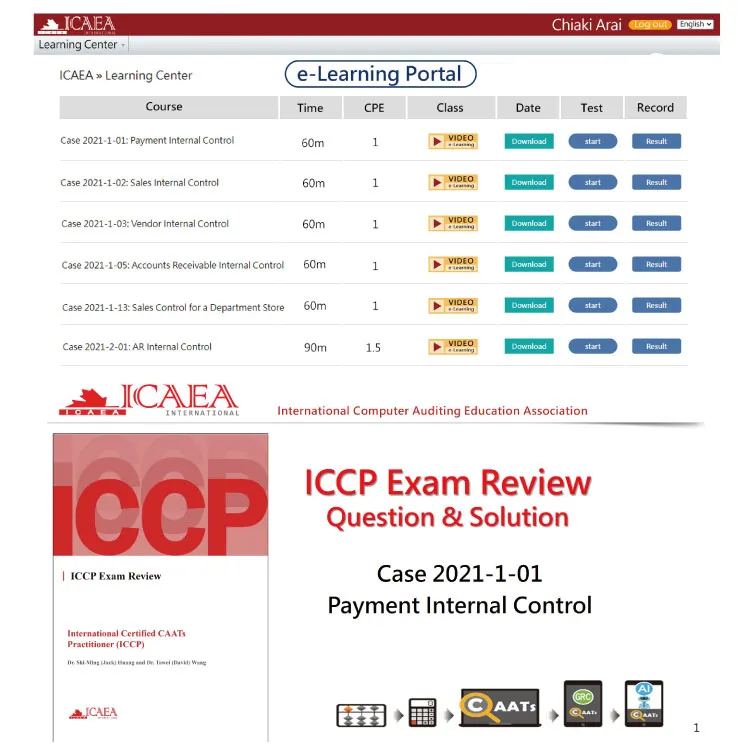
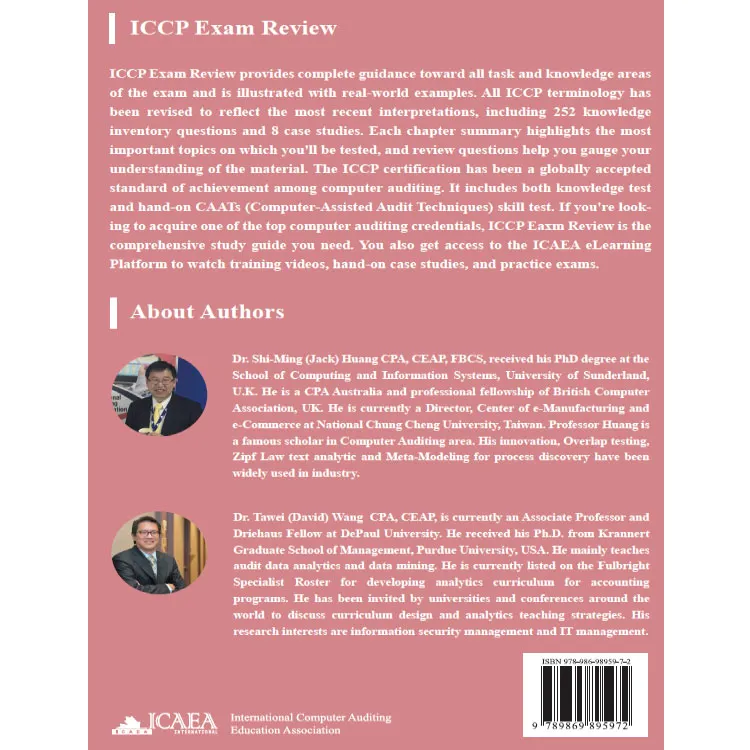
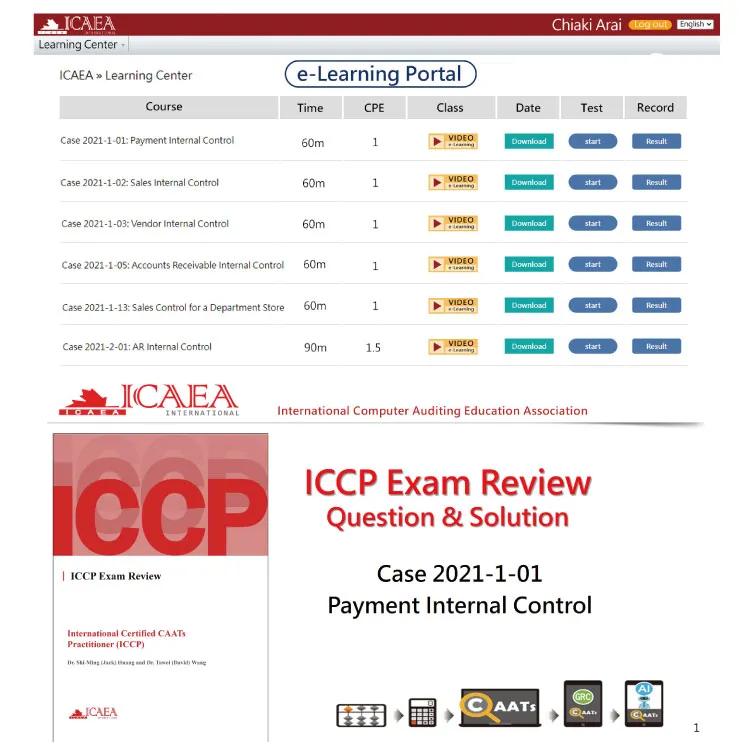
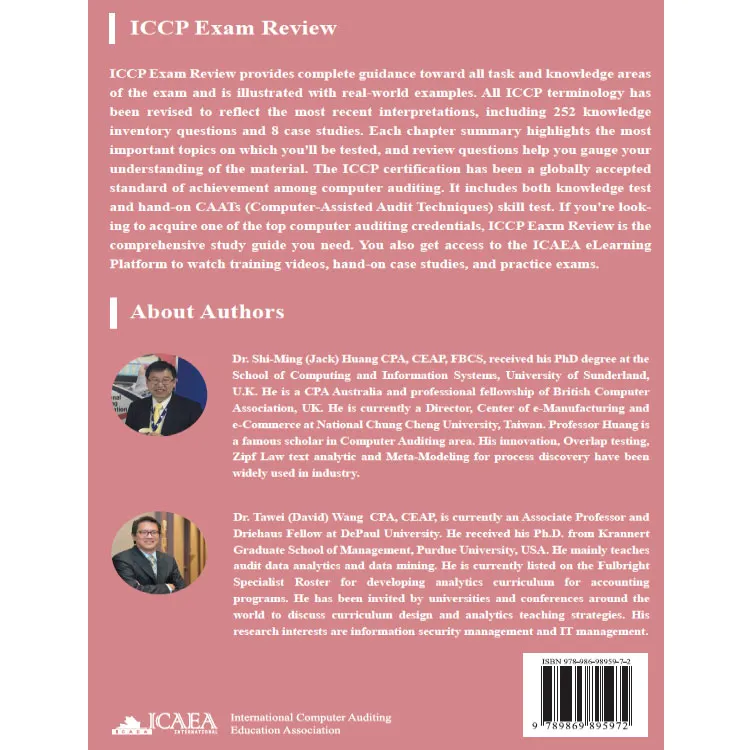


ICCP Exam Review provides complete guidance toward all content areas, tasks, and knowledge areas of the exam and is illustrated with real-world examples. All ICCP terminology has been revised to reflect the most recent interpretations, including 252 knowledge inventory questions and 8 case studies. Each chapter summary highlights the most important topics on which you'll be tested, and review questions help you gauge your understanding of the material. You also get access to the ICAEA eLearning Platform to watch the training videos, practice the case studies, and practice the exams.
For those who audit, control, monitor, and assess enterprise digital data, the ICCP certification signals knowledge, skills, experience, and credibility that delivers value to a business. This study guide gives you the advantage of detailed explanations from a real-world perspective, so you can go into the exam fully prepared. ICCP exam includes both knowledge test and hand-on CAATs (Computer-Assisted Audit Techniques) skill test. The ICCP certification has been a globally accepted standard of achievement among computer auditing in more than 20 countries. If you're looking to acquire one of the top computer auditing credentials, ICCP Eaxm Review is the comprehensive study guide you need.
ICCP Exam Review (ICCP 國際電腦稽核軟體應用師考試總複習) 提供參加考試者完整的學習指引,包含各領域所需專業知識並提供實際案例演練資料提高學習效果。所有 ICCP 國際電腦稽核軟體師應用專業術語都經過修訂,來反應最新的趨勢,內容包含超過250題知識觀念題與 8個實務案例上機題。每章摘要說明讓您了解測試重點主題,透過模擬考題演練協助您衡量對考試內容的精鍊度。您還可以透過ICAEA國際電腦稽核教育協會(www.icaea.net)的數位學習平台,觀看線上課程影片、練習案例研究與熟悉考試方式。
對於稽核、控制、監督與進行企業資料分析的人來說,通過ICCP 國際電腦稽核軟體應用師認證考試,證明可以為企業帶來具有價值的知識、技能、經驗和信譽。本學習指南從實務的角度為您提供詳細釋例,協助您充分準備後,順利參加考試。 ICCP 國際電腦稽核軟體應用師除了電腦稽核與法遵科技應用之知識觀念題外,另有CAATs(電腦輔助稽核軟體)實務案例上機技能測驗,共兩部分考試。 ICCP 國際電腦稽核軟體應用師認證已成為全球 20 多個國家電腦稽核的重要標準,若您有志取得此專業證照,幫您的職涯加分加薪,ICCP Eaxm Review 是您需要的綜合學習指南。
This book attempts to help readers prepare themselves for the basic analytics skills that can be applied to different auditing contexts. By working through exercises and problems with different difficulty levels, readers may find it in- teresting and helpful. Readers can also rely on this book when preparing for the certification exam that may advance their skills and career in the future.
【作者序】
With the advance in information technology, organizations are now able to collect and leverage on a wide variety of data and techniques for decision making. Data analytics is one of the techniques that have been emphasized in recent years. It not only supports business decisions but also can be applied to audit engagements. Though data analytics relies heavily on the understanding of business operations to make sense of the findings, its techniques require practices in order to apply them to different scenarios.
As the authors, we would like to thank the editorial team’s great efforts in making this book possible. This is the first edition and can still be improved substantially. We would appreciate and welcome corrections and suggestions.
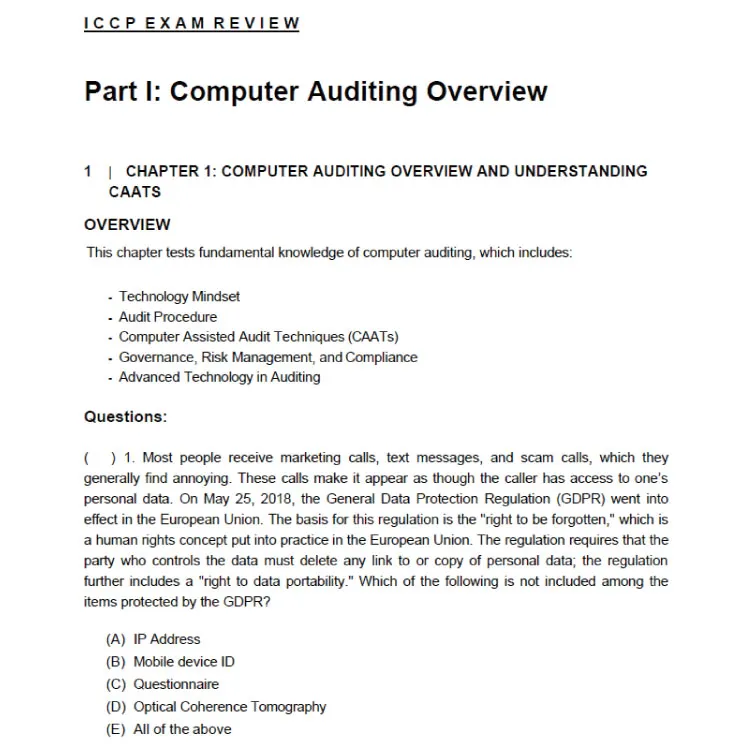
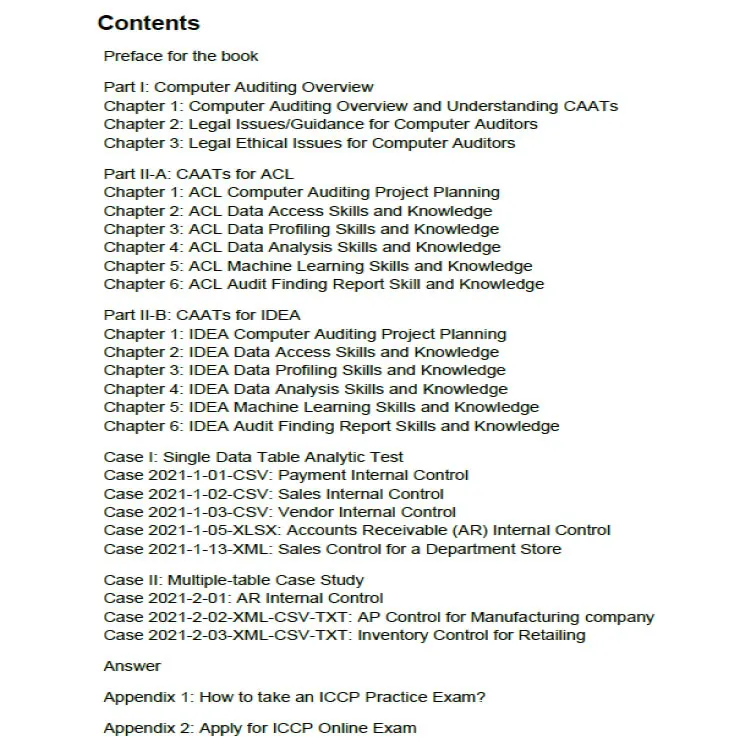
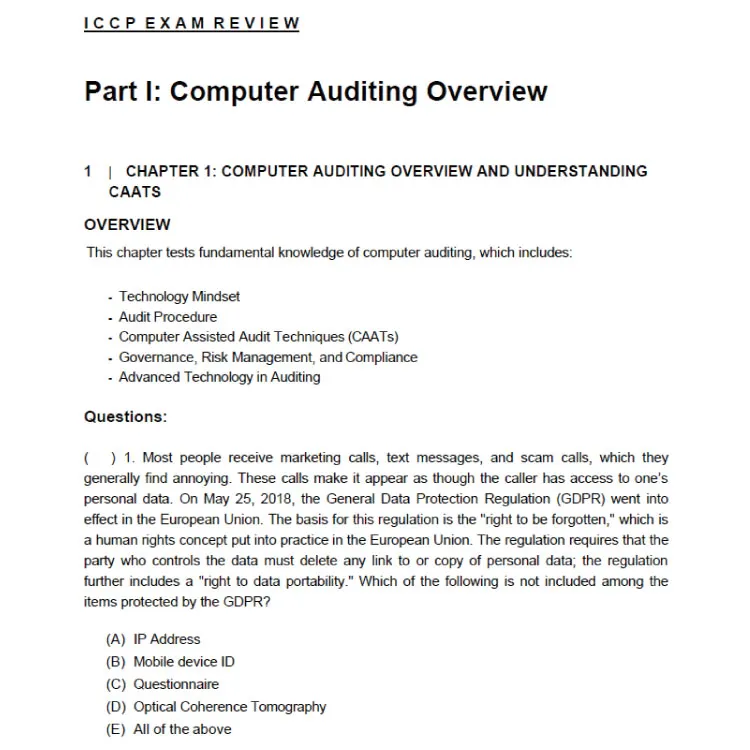
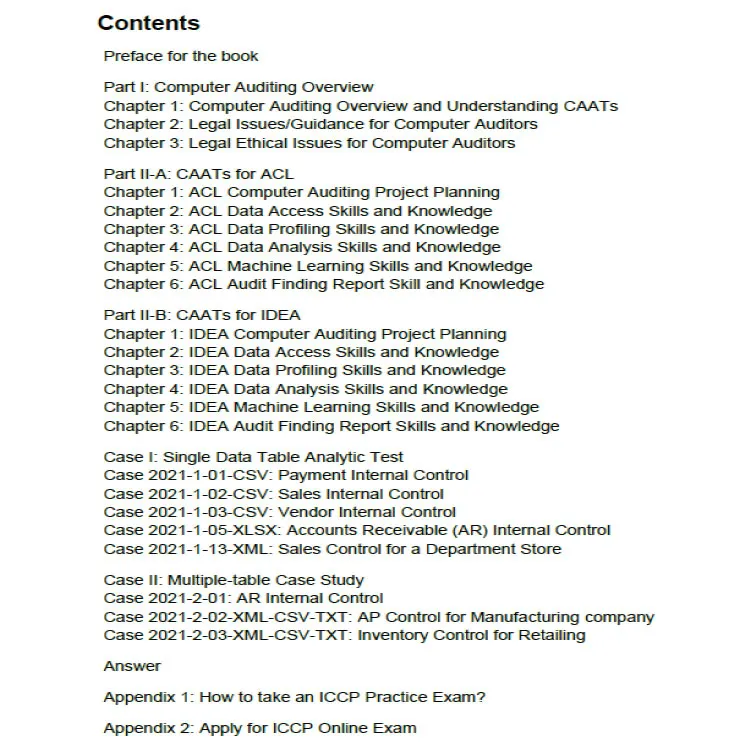
Part I: Computer Auditing Overview
Chapter 1: Computer Auditing Overview and Understanding CAATs
Chapter 2: Legal Issues/Guidance for Computer Auditors
Chapter 3: Legal Ethical Issues for Computer Auditors
Part II-A: CAATs for ACL
Chapter 1: ACL Computer Auditing Project Planning
Chapter 2: ACL Data Access Skills and Knowledge
Chapter 3: ACL Data Profiling Skills and Knowledge
Chapter 4: ACL Data Analysis Skills and Knowledge
Chapter 5: ACL Machine Learning Skills and Knowledge
Chapter 6: ACL Audit Finding Report Skill and Knowledge
Part II-B: CAATs for IDEA
Chapter 1: IDEA Computer Auditing Project Planning
Chapter 2: IDEA Data Access Skills and Knowledge
Chapter 3: IDEA Data Profiling Skills and Knowledge
Chapter 4: IDEA Data Analysis Skills and Knowledge
Chapter 5: IDEA Machine Learning Skills and Knowledge
Chapter 6: IDEA Audit Finding Report Skills and Knowledge
Case I: Single Data Table Analytic Test
Case 2021-1-01-CSV: Payment Internal Control
Case 2021-1-02-CSV: Sales Internal Control
Case 2021-1-03-CSV: Vendor Internal Control
Case 2021-1-05-XLSX: Accounts Receivable (AR) Internal Control
Case 2021-1-13-XML: Sales Control for a Department Store
Case II: Multiple-table Case Study
Case 2021-2-01: AR Internal Control
Case 2021-2-02-XML-CSV-TXT: AP Control for Manufacturing company
Case 2021-2-03-XML-CSV-TXT: Inventory Control for Retailing
Answer
Appendix 1: How to take an ICCP Practice Exam?
Appendix 2: Apply for ICCP Online Exam
Professor Huang is a famous scholar in Computer Auditing and AI for SDGs. He is the President for International Computer Auditing Education Association (based on Canada). He was the President for International Chinese Information Systems Association (ICISA, based on USA). He serves as a board member for several finical institution, such as PwC Education Foundation (Taiwan), Small and Medium Enterprise Credit Guarantee Fund of Taiwan, etc. Two of his books have sale more than 20,000 copies. His innovation, Overlap testing, Zipf Law text analytic and Meta-Modeling for process discovery have been widely used in industry.
2.Dr. Tawei (David) Wang CPA, CEAP, is currently an Associate Professor and Driehaus Fellow at DePaul University. He received his Ph.D. from Krannert Graduate School of Management, Purdue University, USA. He mainly teaches audit data analytics and data mining. He is currently listed on the Fulbright Specialist Roster for developing analytics curriculum for accounting programs. He has been invited by universities and conferences around the world to discuss curriculum design and analytics teaching strategies. His research interests are information security management and IT management.
His papers have appeared in several leading journals, including Accounting Horizons, Decision Support Systems, European Journal of Information Systems, Information and Management, Information Systems Journal, Information Systems Research, International Journal of Accounting Information Systems, Journal of Accounting and Public Policy, Journal of Banking and Finance, Journal of Information Systems, among others. He is one of the editors of the Journal of Information Systems. He has actively engaged with the professional community. He was a speaker for the Institute of Internal Auditors, the Institute of Management Accountants, ISACA, and a panelist for the Federal Reserve Bank Charlotte. In 2018, he was selected to be the KPMG James Marwick Professor in Residence.
- 開本: 24.6x17.1cm
- 頁數: 144
- 單/彩色: 單色
- ISBN: 9789869895972
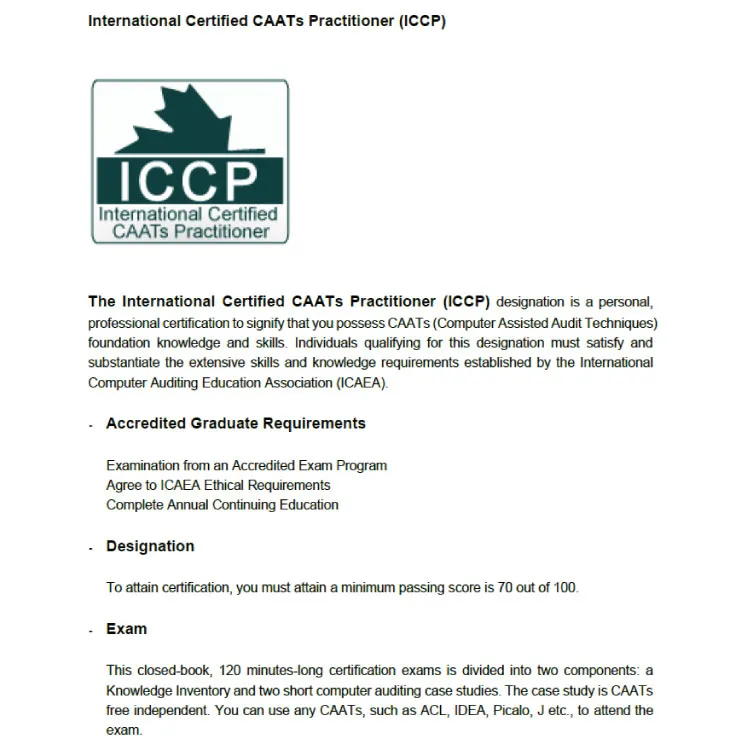
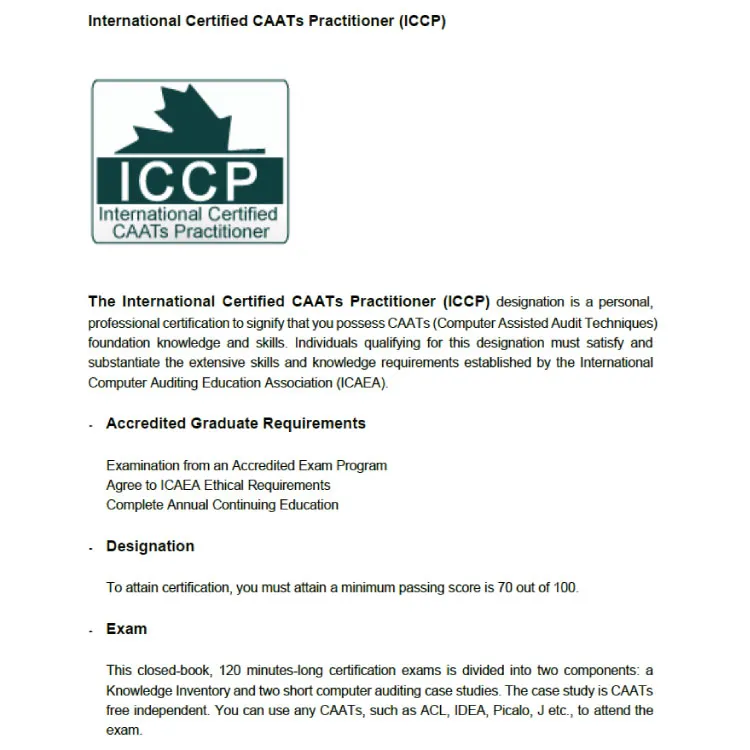
The International Certified CAATs Practitioner (ICCP) designation is a personal, professional certification to signify that you possess CAATs (Computer Assisted Audit Techniques) foundation knowledge and skills. Individuals qualifying
for this designation must satisfy and substantiate the extensive skills and knowledge requirements established by the International Computer Auditing Education Association (ICAEA).
• Accredited Graduate Requirements
Examination from an Accredited Exam Program
Agree to ICAEA Ethical Requirements
Complete Annual Continuing Education
• Designation
To attain certification, you must attain a minimum passing score is 70 out of 100.
• Exam
This closed-book, 120 minutes-long certification exams is divided into two components: a Knowledge Inventory and two short computer auditing case studies. The case study is CAATs free independent. You can use any CAATs, such as ACL, IDEA, Picalo, J etc., to attend the exam.
• Knowledge Inventory
The Knowledge Inventory component of the exam counts for 60 percent of the final grade. It is meant to test your familiarity with professional knowledge and analysis of practical application. The exam consists of multiple choice covering nine topics:
• Computer Auditing Overview and Understanding CAATs
• Legal Issues/Guidance for Computer Auditors
• Legal Ethical Issues for Computer Auditors
• Computer Auditing Project Planning
• Data Access Skills and Knowledge
• Data Profiling Skills and Knowledge
• Data Analysis Skills and Knowledge
• Machine Learning Skills and Knowledge
• Audit Finding Report Skill and Knowledge
• Case Study
The Case Study component of the exam counts for 40 percent of the final grade. It is meant to test your familiarity with CAATs and auditing skills. The exam consists of fill-in-the-blank, and short-answer questions covering three topics:
• Topic 1: Data Access & Integrity Verification
• Topic 2: Data Cleaning and Exploratory Analysis
• Topic 3: Audit Analysis
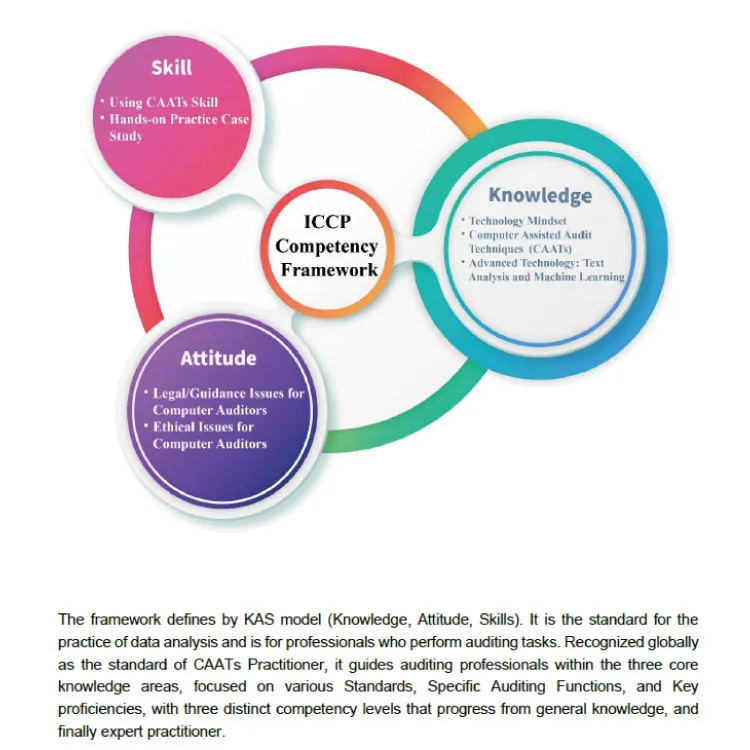
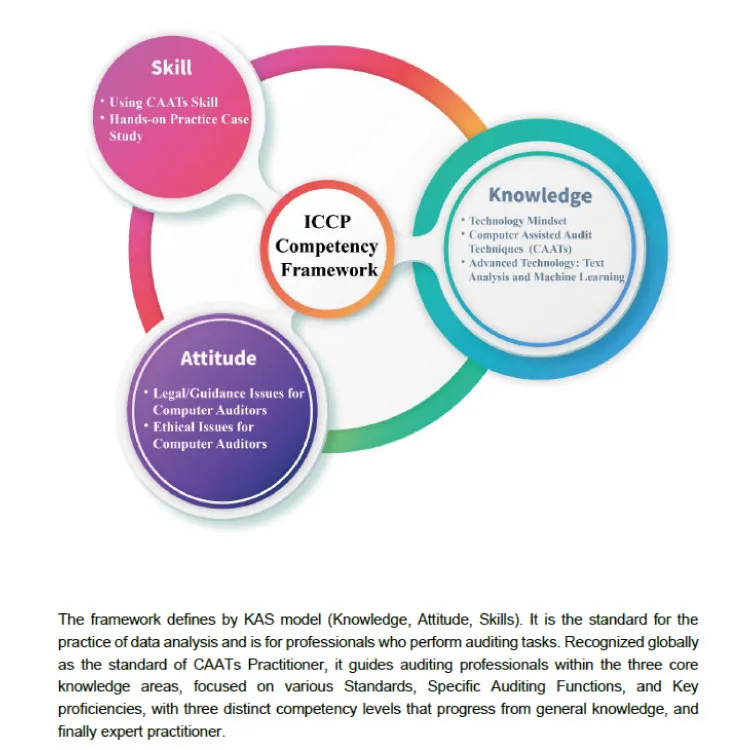
Introducing ICCP Competency Framework
The competency is the basic standard for all auditors when providing audit services by using CAATs. The practice of a good auditor begins primarily in the study of the computer auditing program and in the preparation of an auditor with high efficiency information technology skills in auditing.
The framework defines by KAS model (Knowledge, Attitude, Skills). It is the standard for the practice of data analysis and is for professionals who perform auditing tasks. Recognized globally as the standard of CAATs Practitioner, it guides auditing professionals within the three core knowledge areas, focused on various Standards, Specific Auditing Functions, and Key proficiencies, with three distinct competency levels that progress from general knowledge, and finally expert practitioner.