
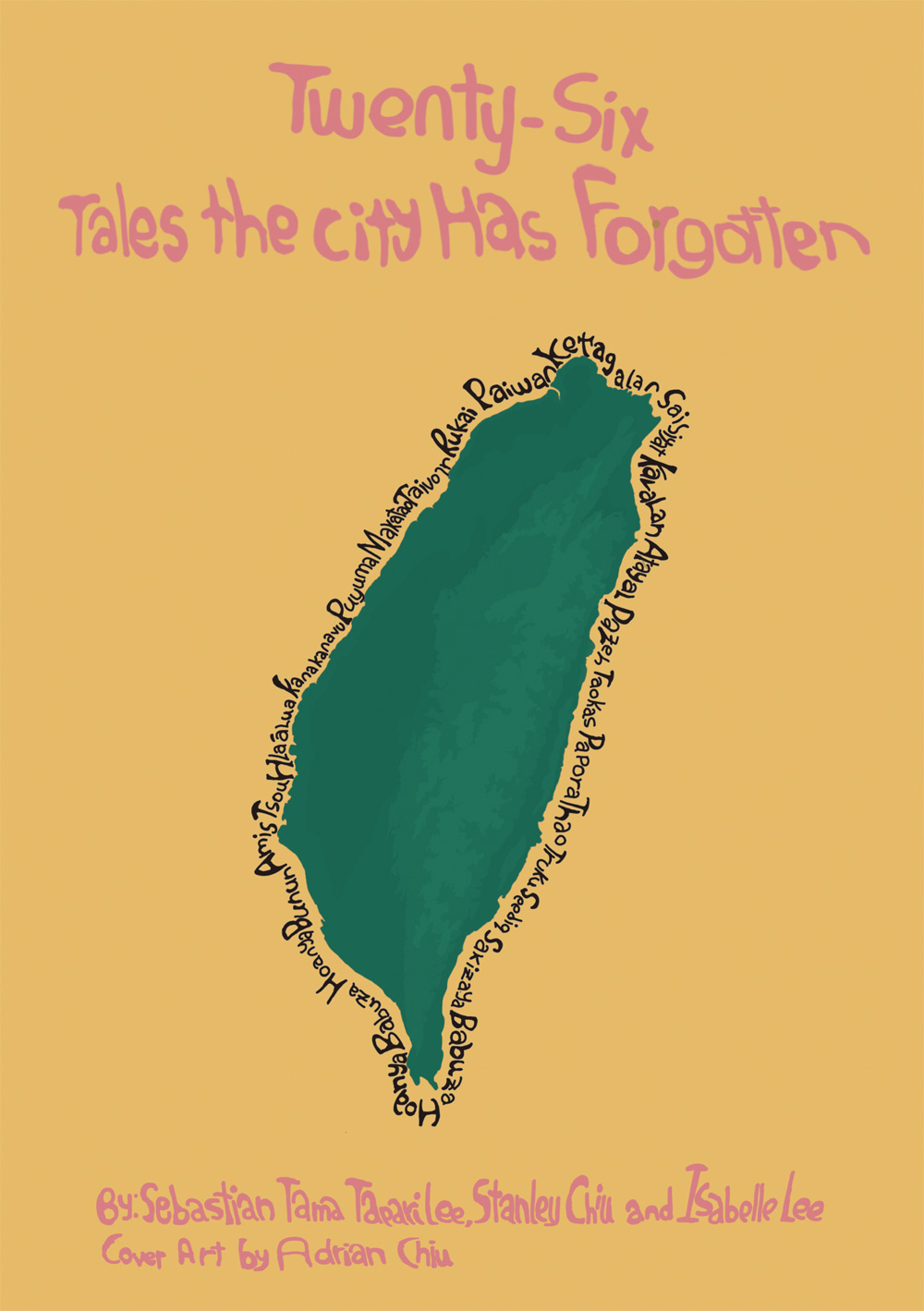
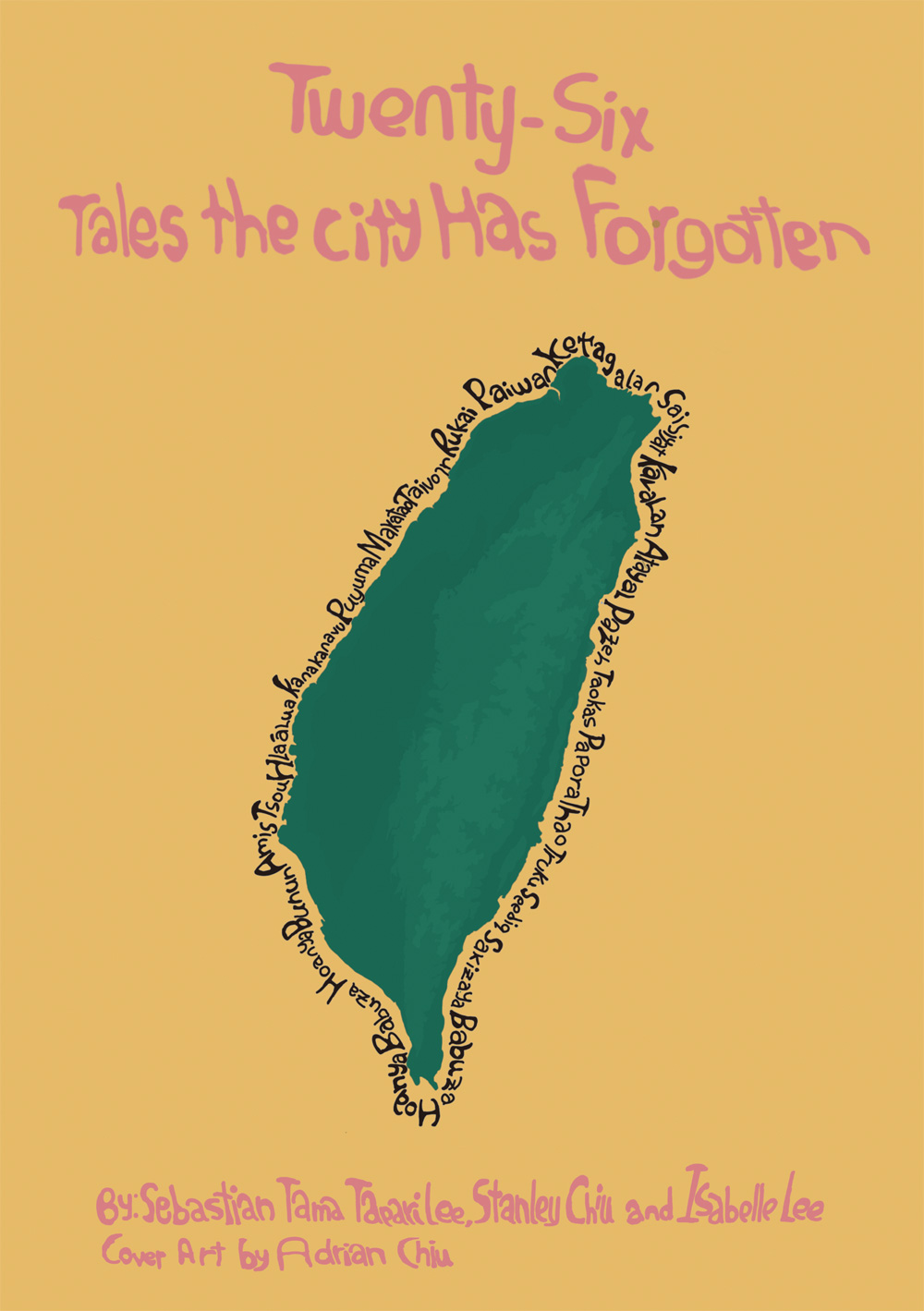
Twenty-Six Tales the City has Forgotten
- 作者: Sebastian Lee, Stanley Chiu, Isabelle Lee, Adrian Chiu
- 出版社: 白象文化
- 出版日期: 2026.10.01
- 分類建議: 外文書


◎Twenty-six stories, one for each of Taiwan's Indigenous peoples: sixteen recognized, ten still fighting for it.
◎Old narratives meet the present, weaving themes of queer identity and technology into questions of cultural survival.
◎From creation myth to testimony, deathbed reverie to near-future tale, each story takes a different form.
Together these stories range across the whole of time, from a creation myth to a tale set in the near future, passing through Dutch, Qing, Japanese, and Republican rule and into the present day. They are told in many shapes — as oral myth and courtroom testimony, as a tour-boat monologue and a child's school worksheet, as a deathbed reverie, an epic chronicle, and a government application form filled in line by line. What they share is only a method: each one tries to find the single story that belongs to its people and to no other.
Two threads run quietly through the cycle, and both were placed there deliberately, because both belong to the present and the future of these peoples and not only to their past.
The first is the lives of LGBTQ people. Four of the stories — among the Amis, the Kavalan, the Taivoan, and the Pazeh — are built around queer lives, and each takes up a wholly different facet of the subject: what it is to be held by a tradition capacious enough to have room for you; what it is to love in a time and place that has no word yet for what you are; the plain joy of a chosen family that simply shows up and stays; and the cost, paid in full and never refunded, of refusing to stop being yourself on someone else's command. These stories are not grafted onto their cultures from outside. They grow from within them — from a matrilineal house and its men's age-sets, from a world whose shame was imported rather than native, from a rebuilt village deciding for itself who counts as family. They are here because queer Indigenous people are not a footnote to these communities but a living part of them, and because to recover an Indigenous history fully is to recover its queer dimension too. In a century increasingly willing to see such lives, a cycle like this one would be incomplete without them; their inclusion is not a gesture but a correction.
The second thread is technology. Six of the stories — among the Tao, the Puyuma, the Truku, the Hla'alua, the Siraya, and the Ketagalan — turn on some piece of modern or near-future technology, and again each puts it to a different use: a radiation-sensor network and the question of who owns the data that proves a wrong; a heritage video game that can be a door to an initiation but never the initiation itself; drones and laser scanning that carry a grieving elder home to a village the maps have lost; an artificial intelligence that speaks a dying language flawlessly and still cannot be said to know it; handwriting recognition that wakes a sleeping tongue out of` the ancestors' own land deeds; and an augmented-reality layer that lets the dispossessed witness the city that was taken from them. Technology is the axis on which the old, false framing — Indigenous peoples as relics, fit only for the museum and the past tense — finally breaks. It appears here as a genuinely double-edged thing, as much a threat as a tool, raising some of the hardest questions a culture under pressure can face: whether a language lives in a database or in a living mouth, whether visibility is recovery or only spectacle, who holds sovereignty over a people's own information. These are twenty-first-century questions, and Indigenous peoples are not standing outside them waiting to be asked; they are already inside them, deciding. The stories insist on that future tense.
The recognized peoples
Bunun — The Seed at the Gate
Tao (Yami) — Counts Per Minute
Paiwan — The Sun's Tear
Amis — The House and the Shore
Atayal — The Bridge Will Know Me
Puyuma — Continue?
Rukai — Lilies for Balenge
Tsou — I Was Nineteen
Saisiyat — Wind Clan
Thao — Promised Land
Kavalan — Joinings
Truku (Taroko) — Point Cloud
Sakizaya — Say the Name
Hla'alua (Saaroa) — Fluent
Kanakanavu — You Who Fed Us
Seediq — The Far Bank
The Pingpu (plains) peoples
Siraya — Sinckan Hand
Makatao — Still Water
Taivoan — Who Shows Up
Pazeh — Ai-yan
Ketagalan — Ketagalan Boulevard
Babuza — Haibos
Hoanya — Dragon Eyes
Kaxabu — Twelve and One
Papora — King of the Sun
Taokas — Please Provide Evidence
Author's Note
Sebastian Tama Tapari Lee is currently an Indigenous student at Taipei American School dedicated to preserving and celebrating Indigenous culture. Inspired by his heritage and the Indigenous people he has met, he hopes to document culture so they remain remembered and carried forward for generations to come.
Stanley Chiu
Stanley Chiu is a 17-year-old student at Taipei American School. Born in Los Angeles to Taiwanese parents, he moved to Taiwan at the age of three. Passionate about STEM, he enjoys exploring the intersection of science, history, and culture. Inspired by the depth of Indigenous Taiwanese scientific and agricultural knowledge—and by how its lasting contributions to society are often underrecognized—he wrote this book to highlight and celebrate that important legacy.
Isabelle Lee
Isabelle Lee studies biomedical engineering at Johns Hopkins University and is an alumna of Taipei American School. Having grown up in Taiwan, she draws inspiration from the island's landscapes, cultures, and stories. She hopes to combine fiction and medical device innovation to create more inclusive futures for indigenous communities.
Adrian Chiu
Adrian Chiu is a 14-year-old student with a passion for art. He has been drawing since early childhood and has explored a wide range of artistic styles and genres. Through his illustrations, he enjoys bringing ideas and stories to life while continually developing his creative skills. This book reflects his dedication to using art to inspire.
- 分級: 普遍級
- 開本: G16K(長21x寬14.8 x厚 1.1cm)
- 頁數: 226
- 單/彩色: 單色
- ISBN: 9786267826621
- 版次: 初版
Author's Note
We began this book as students, and we finish it as students still: only older, and, we hope, a little more worthy of the stories we have tried to carry.
The three of us, Sebastian Tama Tapari Lee, Stanley Chiu, and Isabelle Lee, started drafting these pages nearly four years ago, in the classrooms and late evenings of an international school education that taught us the histories of many distant places while the deepest history of this island sat, largely unspoken, beneath our feet. Taiwan is home to peoples whose presence here stretches back thousands of years before any flag was planted on its shores. Sixteen of them are recognized by the state; ten more, the Pingpu, the plains peoples, spent generations being told, in registers and forms and silences, that they had somehow ceased to exist. This book was written in the conviction that they never did.
What began as curiosity became an obligation. We read of night songs taught in disguise because the language had no official status, of names restored one court ruling at a time, of villages that survived four successive empires by simply refusing to stop being themselves. The more we read, the more we understood that remembrance is not a passive act. Cultures are not lost the way keys are lost. They are taken, suppressed, legislated against, and renamed; and they are kept alive by deliberate, stubborn, daily acts of memory. This book is our small attempt to join that keeping.
We want to be honest about what we are and what we are not. We are not elders. We are not scholars with decades in the field, and we do not speak for any of the twenty-six peoples in these pages. No book could, and certainly not ours. We are three young people who read everything we could find, checked it, questioned it, rewrote it, and tried above all to listen. The glossaries and notes that follow each story exist because we believe respect begins with transparency: what in these pages is documented history, and what is our invention, is set out plainly, so that no reader mistakes our imagination for a people's truth. Where we have erred despite our care, the fault is ours alone, and we ask for correction as a gift rather than a rebuke.
Two choices in this book were deliberate, and we stand by them. We wrote of queer Indigenous lives because they are not a footnote to these communities but a living part of them, past and present. And we wrote of technology, of sensors and scans, databases and games, because the oldest and laziest injustice done to Indigenous peoples is to speak of them only in the past tense. The peoples in this book are not relics. They are neighbors, students, engineers, teachers, and singers, standing inside the twenty-first century's hardest questions and answering them on their own terms.
If this book does anything at all, we hope it does this: that a reader who finishes it can no longer look at this island the same way, and that behind every place name they now hear an older name, and behind every official history, a longer one. Learn the names. Seek out the communities' own voices, which are richer than anything we could write. Remembrance, we have learned, is not something one generation completes for another. It is a song passed hand to hand in the dark, and it only survives if each of us, when it reaches us, chooses to sing.
To the twenty-six peoples of this island, those recognized and those still made to fill in forms to prove what was always true, this book is offered in gratitude, in apology for all that was taken, and in the certain knowledge that you were here first, are here still, and will be here long after.
We were students when we started. We are witnesses now.
Sebastian Tama Tapari Lee, Stanley Chiu, and Isabelle Lee
Bunun — The Seed at the Gate
A story of the Bunun people, guardians of the Central Mountain Range
Sit. Closer, where the fire can reach you. You have asked me why we cut marks into wood when no other people in these mountains do, and why the old men bow to the moon and not only to the sky, and why your mother soaked the millet on the night she did and not the night before. These are not three questions. They are one question, and the answer is a walk that began before I was born and ended when I was an old man, and I am the only one left who took it. So listen, because when I am gone the walk goes with me unless it goes into you.
In the time called minbakaliva (the time when nothing held its shape, when a woman might give birth after watching a snake shed its skin, when men were made from stone and children from worms) there were two suns. Not one sun and one moon as you have always known. Two suns, and they took the sky in turns, so that there was no night anywhere on the earth, no shadow under any leaf, no cool hour in which a person might rest. The rivers grew thin and then white and then gone. The millet curled brown in the field before it was a hand high. And the worst thing, the thing the old men still will not say above a whisper: a mother set her infant on a sleeping-mat of skin in what little shade there was, and went to the dry stream for water, and when she came back the child on the mat had been baked by the two suns into a lizard, and the lizard ran from her into the rocks. This happened in more than one house. This happened until the mothers stopped setting their children down at all.
My father was a young man then, and I was the child on his back. He did not set me down. He bound me to his shoulders with a carrying-cloth and he took up his bow and a quiver of the long arrows, and he said to the people at the gate of our village: I am going to where the suns climb out of the ground, and I am going to put out the eye of one of them, so that our children can sleep in shadow again. The elders said no man had walked so far and returned. My father did not answer them. At the gate of the village, he pressed a seed into the earth with his thumb, a seed of the bitter orange that grows wild on the slopes, and he said, so that someone will know how long I was gone. Then he turned east, toward the heat, with me asleep against his spine.
I will not pretend I remember the beginning of the walk. I was too small. But I remember its middle, because the walk was so long that I grew up inside it. Understand me: this is the part the cities cannot believe, so they leave it out of the story when they print it, but it is the true heart and you must keep it. The road to the rising place was so far that a baby could be carried out and come home a grown man. I learned to crawl on that road. I learned to walk on that road, beside my father, then ahead of him. I cut my first teeth gnawing dried millet on that road, and I cut my last child-teeth there too. My father's black hair turned the color of ash on that road. His back, which had carried me, began to bend. There came a morning (we were close then, the air shaking like water over a stone, the ground too hot to kneel on) when my father lifted his bow to draw it, and could not. His arms had given everything they had to the walking and the carrying. They trembled and the string would not come back.
So he put the bow into my hands.
That is the thing I most want you to hold, of everything I will tell you tonight. The one who began the walk was not the one who finished it. My father conceived the journey, and endured the years of it, and aimed his whole life at the suns, but his were not the arms that loosed the arrow. He had spent those arms carrying me to the place where I could do it. I had thought, all my growing, that I was the burden of the walk. But I was its purpose.
I drew the bow my father could no longer draw. I had his eye, because he had taught it to me step by step across ten thousand days, and I put the arrow into the eye of one of the suns, and the sun screamed, and its light fell out of it like blood from a wound, and it cooled, and it dimmed, and it became the thing you see now in the night sky and call the moon. And at once, for the first time in the world, a shadow lay down on the ground beside us, cool and gray, and my father wept into it, because he had walked his whole strength away to make that one patch of shade and now it covered the earth.
But the moon was not finished with us. Wounded, dimmed, furious, it came down the sky after us as we turned for home, and it caught us, and it wet its great fingers in its own mouth and pressed us flat against the cool of its palm so we could not run. We thought it would crush us. Instead it bargained. You have put out my eye, the moon said, and I will let you live. But you and your people owe me for this hurt forever. My father offered the only wealth we carried: strips of woven cloth, tapa, to bind the bleeding socket. The moon took them and held them to its eye, and if you look at the full moon tonight you will see them still, the dark cloths laid over the dark wound, the moon turning its hurt toward us across all this distance, asking why.
And then the moon gave us the law, the real reason I have kept you up past sleeping. It said: Watch my face. When I am thin, do this. When I am round, do that. Plant when I tell you, harvest when I tell you, hold your ceremonies by my changing and not by your own forgetting. And if you keep faith with my face, I will keep the night cool for your children. Break faith, forget a single rite, and I will take back the dark. This is why the old men bow to the moon. This is why we soak the millet on the night we soak it and no other. The moon set our whole year in motion the day we wounded it; every ritual you have ever seen is a debt being paid to a thing my father and I injured to save you.
We walked home. It took as long as the walk out, of course, and my father did not finish that walk either. He lies under a stone on the eastern slopes, sitting upright as we bury our dead, facing the road we came by. I came home alone, an old man returning to the village I had left as a sleeping infant on my father's back, and no one knew me. They knew me only when I led them to the gate and showed them the bitter-orange seed my father had pressed into the dust on the morning we left. It was a tree now. It was a tall tree, heavy with fruit, older than any child in the village. That was how long the walk had been. That was the measure he had planted so we would understand.
So. You asked why we cut marks into wood. It is because the moon gave us so many rites to keep, in so exact an order, that one season we mixed them up and the rains came wrong, and we swore never to forget again. And so we cut the moon's whole year into a board of wood, mark by mark, the only people in these mountains to keep our memory in something harder than a mind. Tend it. When I die, the walk is yours: the knowledge that the work which saves a people may take longer than the life of the one who begins it, that the carried child is the point of the carrying, and that we owe the cool dark a debt we will be paying, you and your children's children, by the light of a wound, for as long as there is a night to sleep in.
Now eat your orange. It is from that tree. We have never let it die.
Glossary
˙ Bunun: "people/human," the self-name of the highland people of Taiwan's Central Mountain Range; the highest-dwelling of Taiwan's Indigenous peoples.
˙ minbakaliva: the Bunun term for the primordial, "supernatural" age when the boundaries between humans, animals, stones, and spirits were not yet fixed.
˙ millet: foxtail/oil millet, the staple grain whose growth cycle structured the entire Bunun ritual calendar.
˙ hanitu: spirit/soul; in Bunun belief, every being has hanitu, and a person carries two: an ill-tempered one on the left shoulder, a generous one on the right.
˙ Dihanin: the sky/heaven; the highest power and origin of all things in Bunun cosmology.
˙ tapa: bark or woven cloth strips; in the myth, offered to staunch the wounded sun-become-moon (explaining the dark markings of the full moon).
˙ the picture calendar (Islulusan): a board incised with symbols recording the sequence of agricultural and ritual events; the Bunun are noted as the only Taiwanese Indigenous people to keep such a near-script record.